


Emerging pollutants - Blog 01
- Ursula Fiorela Navarro
- May 25, 2025
- 3 min read

I am currently fascinated by the thousands of chemicals released everyday. But I am not fascinated by the fact of their release, what I find really interesting is the thousands of reactions that can lead to unknown fates and interactions with biota.
It does not matter if it is a fish, a snail, a plant, or you. The interactions of the chemicals with the environment can vary, and it depends on their chemical and physical parameters like molecular mass, boiling point, density, vapour pressure and more. The question is, what are the parameters of those new unknown chemicals?. These are the so-called "Emerging pollutants", because we do not know how is their behavior in the environment.
I am a makeup lover. And everytime I go to a sephora, I am attracted by the shiny colours of the mascaras, eyeliners, and eyeshadows. But I am also a concern environmentalist and I think my own criticism took me to read more about what was behind glitter. Glitter looks pretty right? I know.
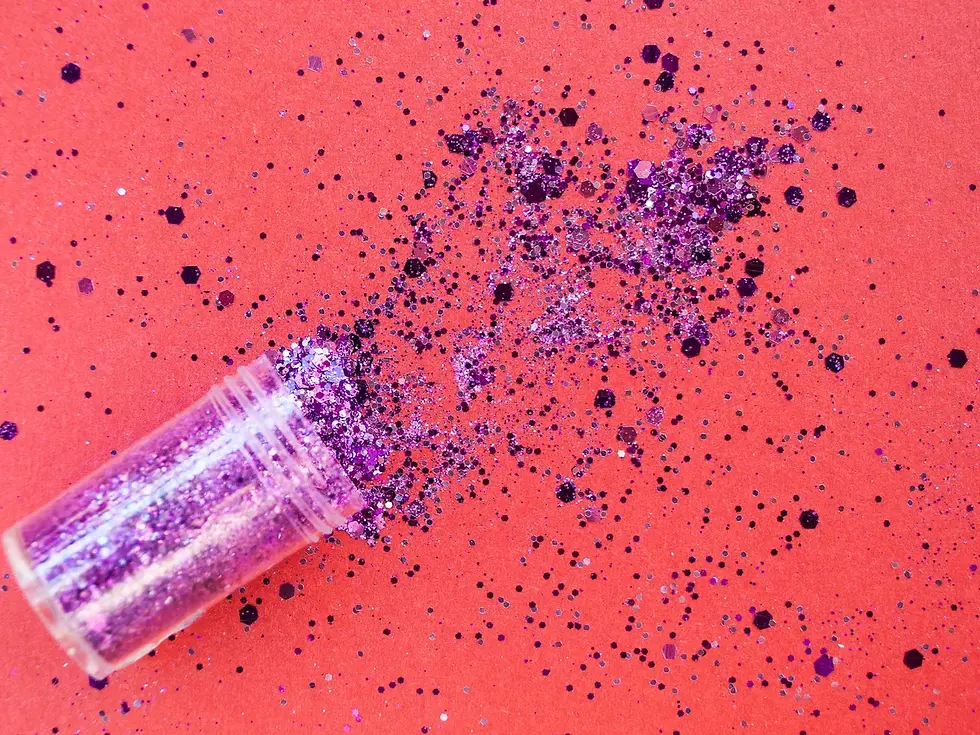
Industries that produce these type of microplastics (yes, glitter is mainly made out from them) are in charge of having their own Wastewater Treatment Plants (WWTP). But as you might realize, we wash our face in the sink and those waters go to a sewage where WWTP are not equiped to deal with these types of microplastics (MPs). In fact, a new method for determine the size, shape, polymer type and partitioning behavior of MPs in WWTPs revealed that the input of glitter to water bodies was from 2.7 to 3.0 × 10⁷ particles/day (Raju et al., 2020)
Microplastics interaction in the environment
In aquatic ecosystems, a large community of organisms can be affected in time and space scale. In time scale, food web interactions have caused pelagic predators (swordfish and tuna), to have a large concentration of MPs, revealing that 18.5% of the control group contained MPs in the Mediterranean Sea (Fazey & Ryan, 2016). On a space scale, MPs concentrations can reach high concentrations near the sources of pollution such as highly populated urban areas with low water exchange (Setälä et al., 2018). The systematic research of (Wootton et al., 2022) concluded that 94% of the oysters monitored globally were recorded with microplastic contamination, with an average of 1.4 pieces per oyster.
In the cosmetic industry, MPs are intentionally added solid microplastics in rinse-off cosmetics used for exfoliation or cleansing, and are categorized as microbeads. On the other hand, glitter comes from metalized polyethylene terephthalate (PET) (aluminum, titanium, iron or bismuth) (Yurtsever, 2019). In the cosmetic industry, glitter is present in mascaras and eye shadows (European Chemicals Agency, 2019); however, other sources include clothing, arts, crafts, and body creams. Recently, new industries have focused on developing “environmentally friendly” glitter. These can come from cellulose or modified regenerated cellulose (MRC) and are coated with aluminum and topped with a plastic layer. Other bio source is natural mica (Green et al., 2021).
I do not want to alarm you with only ugly facts. I want to inform society about our actions in a proper manner. As I mentioned, emerging pollutants are overwhelming our world. Fortunately scientist know this. In Europe, the European Chemicals Agency (ECHA) have proposed a restriction on all added microplastics [1], including glitter, made with PET; however natural polymers and biodegradable alternatives are not involved in the proposal.
Sources
Raju, S., Carbery, M., Kuttykattil, A., Senthirajah, K., Lundmark, A., Rogers, Z., SCB, S., Evans, G., & Palanisami, T. (2020). Improved methodology to determine the fate and transport of microplastics in a secondary wastewater treatment plant. Water Research, 173, 115549. https://doi.org/10.1016/j.watres.2020.115549
Fazey, F. M. C., & Ryan, P. G. (2016). Biofouling on buoyant marine plastics: An experimental study into the effect of size on surface longevity. Environmental Pollution, 210, 354–360. https://doi.org/10.1016/j.envpol.2016.01.026
Setälä, O., Lehtiniemi, M., Coppock, R., & Cole, M. (2018). Microplastics in marine food webs. Microplastic Contamination in Aquatic Environments: An Emerging Matter of Environmental Urgency, 339–363. https://doi.org/10.1016/B978-0-12-813747-5.00011-4
Wootton, N., Sarakinis, K., Varea, R., Reis-Santos, P., & Gillanders, B. M. (2022). Microplastic in oysters: A review of global trends and comparison to southern Australia. Chemosphere, 307(P4), 136065. https://doi.org/10.1016/j.chemosphere.2022.136065
Yurtsever, M. (2019b). Tiny, shiny, and colorful microplastics: Are regular glitters a significant source of microplastics? Marine Pollution Bulletin, 146, 678–682. https://doi.org/10.1016/j.marpolbul.2019.07.009
European Chemicals Agency. (2019). Annex XV Restriction Report. Proposal for a Restriction. Substance Name(s): Intentionally Added Microplastics. Ver 1.2. Helsinki, Finland.
Green, D. S., Jefferson, M., Boots, B., & Stone, L. (2021). All that glitters is litter? Ecological impacts of conventional versus biodegradable glitter in a freshwater habitat. Journal of Hazardous Materials, 402, 124070. https://doi.org/10.1016/j.jhazmat.2020.124070

Comments